
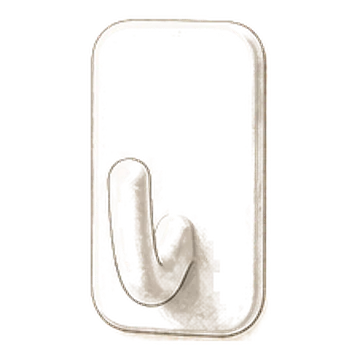
Clear adhesive wall hooks, heavy duty, 12 pack
Clear no-drill hooks for towels, mitts and utensils.
Check priceA rental kitchen comes with someone else's cabinets, someone else's walls and a deposit riding on both. These kitchen storage ideas add real space without drilling, and each one comes with how to install it, what to watch for and how to take it down cleanly when you move.
As an Amazon Associate I earn from qualifying purchases. Links on this page are affiliate links: if you buy through them, I may earn a small commission at no extra cost to you.

Part of our guide: Small Kitchen Organization Ideas: A Zone-by-Zone Plan →
Renter-friendly storage does one of four things: it hangs over a door, it sticks on with removable adhesive, it stands on its own, or it rolls. If an idea needs screws, new hardware or paint, ask your landlord first and get the answer in writing.
Most of the ideas below take minutes to set up. The bigger job is the first one: knowing what your lease allows and recording the condition of the kitchen before you change anything.
Leases differ a lot. Some forbid any holes, some allow small nail holes for pictures, and some say nothing at all. Read the section on alterations and decorating, and when in doubt, send your landlord or property manager a short message describing what you want to add.
Documenting the kitchen protects you whatever the lease says. Photos taken before you change anything make it easy to show the condition of the walls and cabinets at move-out.
Then measure, because rental kitchens often have odd sizes: shallow upper cabinets, a narrow gap beside the fridge or doors that hit each other. A few numbers in your phone stop you from buying racks that do not fit.
A useful rental upgrade has to pass two separate questions: does it fit when in use, and can you remove it in the way its instructions require? A cart avoids attaching anything to the wall, but can still block a door. An over-door rack avoids screws, but its hooks can prevent the door from closing.
For this hypothetical example, use an ordinary storage niche measuring 14 in wide by 22 in deep. It is not an appliance ventilation gap or a service space. A cart with complete outside dimensions of 12 × 20 in leaves 2 in total in each direction. Centered, that is 1 in per side; handles and wheels must already be included in the 12 × 20 in measurement.
A 15 in wide cart exceeds the niche width by 1 in. A 12 × 24 in cart fits across but projects 2 in beyond the available depth. The labels narrow, slim and apartment-sized cannot resolve either mismatch; compare the numbers.
Before choosing the 12 × 20 in option, tape its footprint on the floor and reproduce the action you will use it for. Can the handle be reached, the cart rolled out, a cupboard opened and the path kept usable? Then check the product load and stability instructions. A passing footprint is only the first filter.
For a hanging or adhesive option, record a different set of constraints: door thickness, hook thickness, the closing gap, approved surface and removal access. Follow the exact manufacturer instructions for the product and surface; removable adhesive is not a universal guarantee that paint will be unaffected.
The worksheet below keeps the fit decision separate from the removal decision. Write down the measurements and instructions before shopping, then choose the simplest option that passes both.
| Sample cart | Outside footprint | Width left | Depth left |
|---|---|---|---|
| A | 12 × 20 in | 2 in total | 2 in total |
| B | 15 × 20 in | Exceeds by 1 in | 2 in total |
| C | 12 × 24 in | 2 in total | Exceeds by 2 in |
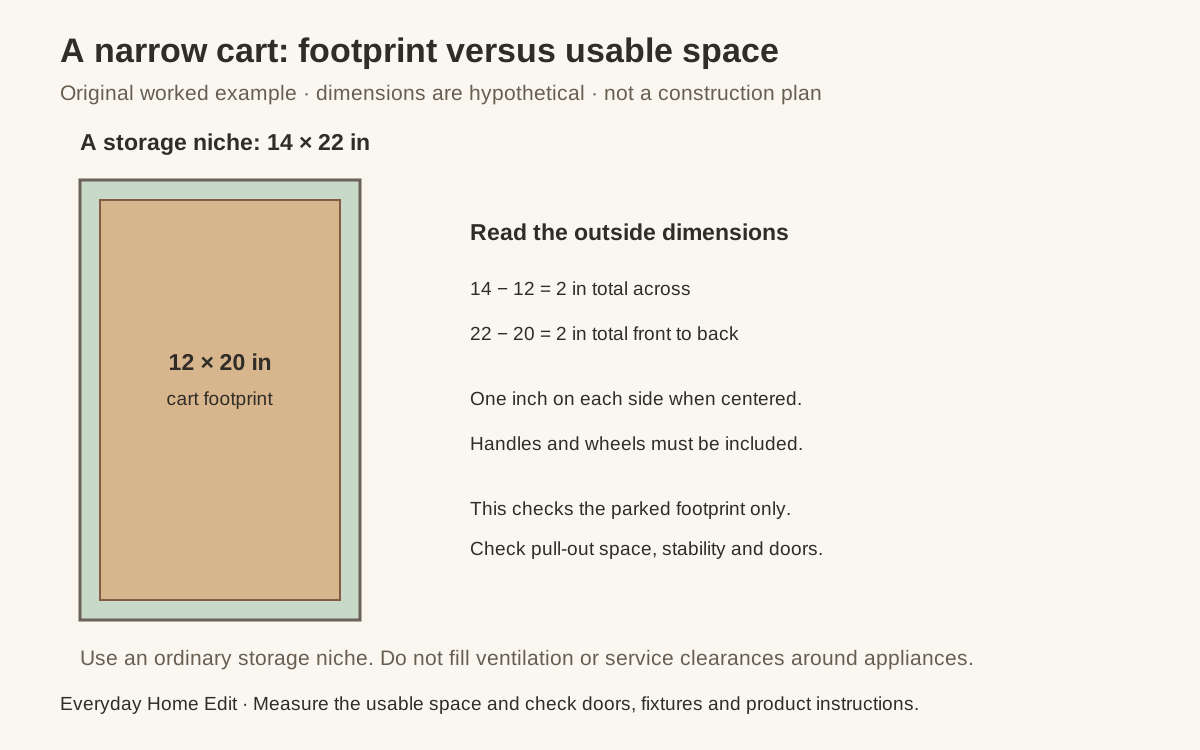
Reference: Command clear-hook application and removal instructions. Worked-example dimensions and arithmetic are our own.
Adhesive hooks are the most useful renter tool in the kitchen. They can hold dish towels on the end of a cabinet, oven mitts beside the stove, measuring cups inside a cabinet door or a broom on the side of the fridge.
There are two common styles. Clear adhesive wall hooks, heavy duty, 12 pack all but disappear on a light wall or a cabinet door and need no drill. Command large utility hooks, 7 pack are made to be damage-free and come with 12 strips, so you have spares to move a hook later.
Placement makes the difference between a hook that holds and one that drops. Use them on smooth, clean surfaces such as painted cabinets, tile or the inside of a door. Clean the spot first so there is no kitchen grease, press firmly, and follow the package directions on how long to wait before hanging anything. Avoid textured walls, wallpaper and freshly painted surfaces, and check the weight rating before you load a hook.
Keep adhesive hooks away from the stove and the dishwasher vent, where heat and steam can soften the adhesive over time.
A door is free storage that needs no tools, as long as the rack hooks over the top. A tall pantry, closet or laundry door can hold as much as a small cabinet.
For cans, jars and snacks, the JARLINK 5-shelf over-the-door organizer adds five shelves with no drilling. For small packets, spices and wraps, the Simple Houseware 15-pocket over-the-door pantry organizer comes as two clear organizers, so you can see what is in each pocket at a glance.
Before you buy, check three things. The door needs a small gap at the top for the hooks, the rack has to clear the frame so the door still closes and latches, and nothing on the shelves can hit a shelf inside the closet when the door swings shut. A strip of felt on the back of the hooks helps protect the paint on the door edge.
Inside cabinet doors, use small adhesive hooks for measuring cups or a pot holder. Measure the depth first, since anything mounted on the door has to clear the shelves inside.

Freestanding pieces are the safest storage for a renter because they touch nothing permanent. They also come with you to the next place, so the money stays useful.
The gap between the fridge and the wall, often only a few inches, is the classic spot. A slim rolling cart like the Simple Houseware 3-tier heavy-duty rolling cart, white is made for it and adds pantry space you pull out when you need it. Measure the gap first and leave a little room so the cart does not scrape the fridge or the wall.
If you have a bit of open floor, a bakers rack or a microwave cart can take a microwave, an air fryer or a coffee setup off the counter. A small kitchen island cart adds both storage and a second prep surface.
Inside the cabinets, use pieces that simply sit on the shelf: risers to split a tall shelf, stackable bins that pull out like drawers and a turntable for a corner. None of them leave a trace when they come out.

Much of the wear in a rental kitchen happens inside the cabinets: rings from oil bottles, scratches from pans and water damage under the sink. A little protection now is far cheaper than a deduction later.
Line the shelves and drawers. The Gorilla Grip drawer and shelf liner is non-adhesive, so it cuts to size, lies flat and lifts straight out at move-out with no residue. It comes 12 inches wide and 10 feet long, enough for several shelves.
Under the sink, a waterproof under-sink silicone mat covers a 34 x 22 inch area and has raised edges to catch drips from the trap or a leaking bottle. It also makes a slow leak easy to spot.
If you do find a leak, tell your landlord right away and in writing. Repairs to the plumbing are usually their job, and reporting early shows the damage was not caused by you.
A tension rod holds itself in place with pressure, so it leaves no marks. Under the sink, one fitted across the cabinet near the top can hold spray bottles by their triggers, which frees the floor of the cabinet for a bin.
Set two short tension rods vertically in a cabinet to file baking sheets, cutting boards and muffin tins on edge. You can pull one out without lifting the rest of the stack.
A short tension rod with a fabric panel turns an open shelf or the space under the sink into closed storage, and it hides the clutter you do not want on view.
Magnetic racks can stick to the side of the fridge for spices or paper towels, but test first: many stainless steel fridge fronts and sides are not magnetic. Check that the rack does not block the door seal or the vents.
Storage is not the only thing renters want to change. A dated backsplash or worn wall behind the counter can make even an organized kitchen feel tired.
Peel and stick backsplash tiles, such as the STICKGOO peel and stick backsplash tiles, cover the wall without grout. Ask your landlord before using them, and test a small piece in a hidden spot first, since adhesives can pull paint or leave residue when removed. Check the product's guidance about heat before placing any near the stove.
Cabinet knobs can often be swapped using the existing holes. Keep the originals in your labeled move-out bag and put them back on the last day.

Every tier here is portable, so whatever you buy keeps working in the next kitchen. Start with the problem you meet every day and work outward.
Give yourself an hour or two in the last week to undo everything. Rushing adhesive removal on moving day is how paint comes off with the hook.
Clear no-drill hooks for towels, mitts and utensils.
Check priceDamage-free adhesive wall hooks for coats, bags and towels.
Check price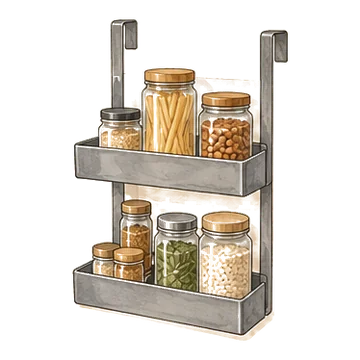
A five-shelf rack that hangs on a door for cans, jars and snacks.
Check price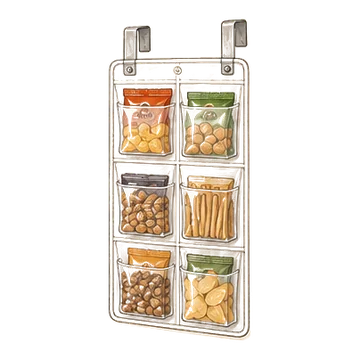
Two clear 15-pocket organizers that hang over a pantry or cabinet door.
Check price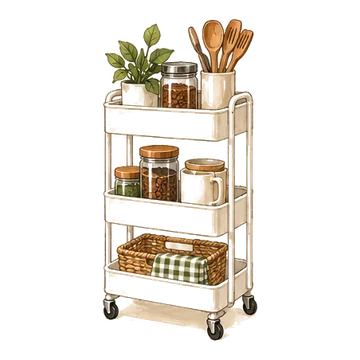
A white metal three-tier cart that adds pantry space between the fridge and wall.
Check price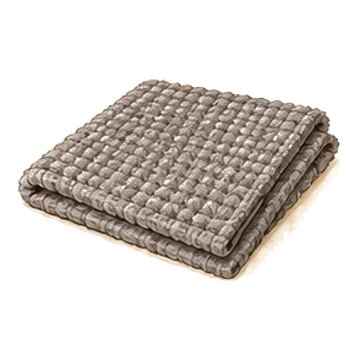
A thick non-adhesive liner that protects kitchen cabinets and drawers.
Check priceA silicone tray with raised edges that protects the cabinet under the sink from drips and leaks.
Check price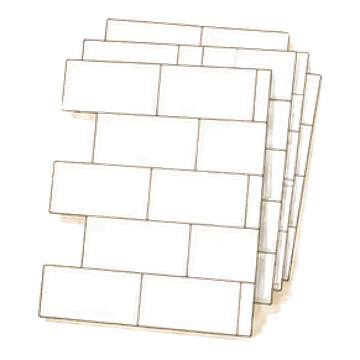
Self-adhesive backsplash tiles that cover an outdated wall without grout.
Check priceUse over-the-door racks, removable adhesive hooks, tension rods, freestanding carts and racks, and risers, bins and turntables inside the cabinets.
They are designed to come off cleanly when used and removed as directed. Use them on smooth, clean surfaces, avoid fresh paint and wallpaper, and test one in a hidden spot first.
Ask your landlord first. Test a small piece in a hidden spot, since adhesive can pull paint or leave residue, and check the product's heat guidance before using it near the stove.
Try a slim rolling cart beside the fridge, an over-the-door rack on a pantry or closet door, and a cabinet near your prep area set aside for food.
Line shelves and drawers with non-adhesive liner, put a waterproof mat under the sink and report any leaks to your landlord in writing right away.
Often yes, if the new knobs use the existing holes and your lease allows it. Keep the originals in a labeled bag and put them back before you move out.


