
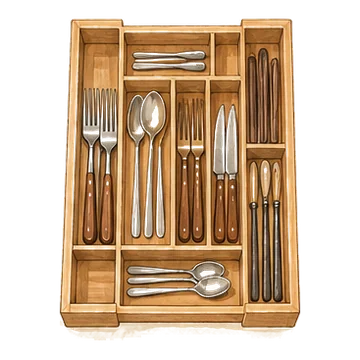
Pipishell expandable bamboo silverware organizer, large
A bamboo drawer tray that expands to fit the drawer wall to wall.
Check priceIn a small kitchen, every drawer has to earn its place. The trick is not more organizers but a clear job for each drawer, trays that fit wall to wall and nothing stacked so high the drawer catches. This guide covers how to plan, measure and set up each type of drawer, with a printable plan at the end.
As an Amazon Associate I earn from qualifying purchases. Links on this page are affiliate links: if you buy through them, I may earn a small commission at no extra cost to you.

Part of our guide: Small Kitchen Organization Ideas: A Zone-by-Zone Plan →
Many small kitchens have only three to five drawers, so the order of operations matters. Decide what each drawer is for based on where it sits, edit what goes in it, measure the inside, then buy trays or dividers that fill it from side to side.
Plan about 20 to 30 minutes per drawer, or an afternoon for the whole kitchen. Do one drawer at a time so the counter never disappears under piles.
Shallow top drawers are for flat, everyday tools in a single layer. Deep bottom drawers are for bulky things stored upright. Mixing the two is where most drawer clutter starts.
Store things where you use them. A drawer is only convenient if it is within a step of the task, so start by looking at what sits above and beside each one.
The drawer closest to the dishwasher, or between the dishwasher and the table, is the best spot for silverware. Unloading takes seconds when the basket and the tray are side by side.
The drawer nearest the stove gets cooking utensils: spatulas, spoons, tongs, a ladle and a whisk. If there is a drawer near your main prep counter, it holds knives in a guarded block, peelers, measuring cups and spoons.
Foil, wrap and storage bags belong near where you pack leftovers, often by the fridge. Dish towels and pot holders go in the drawer closest to the sink or stove. If one location has to do double duty, split the drawer down the middle with dividers rather than letting two categories mix.
Drawer organizers get returned more than almost anything else in the kitchen, usually because they were sized to the front of the drawer. In a standard 24-inch-deep base cabinet, the drawer box inside is usually shallower, often somewhere around 18 to 22 inches deep, and the slides take up width on each side.
Small kitchens collect duplicates: three spatulas, two can openers, a drawer full of specialty gadgets used once. Before any tray goes in, cut each category down to what you actually reach for.
Put everything from one category on the counter and keep the favorite of each tool. Keep a second only if you regularly use two at once, like two wooden spoons on a busy cooking night. Put single-use gadgets, such as a garlic press you never use, in a box for a month; if you do not open the box, donate it.
For silverware, keep enough to get through one full dishwasher cycle plus a few extras for guests. Anything beyond that is just weight in the drawer.
A tray that fits the drawer wall to wall is what keeps a utensil drawer neat. Any gap along the side becomes a spot where loose tools pile up and slide around every time the drawer opens.
Expandable trays solve the sizing problem. The Pipishell expandable bamboo silverware organizer is a large bamboo tray that expands to fit the drawer from wall to wall, so the side compartments fill the space a fixed tray would leave empty. It works well for silverware in the drawer by the dishwasher.
Cooking utensils are longer and bulkier. The Lifewit extra-large expandable silverware organizer is an extra-large expandable tray for silverware and cooking utensils, which makes it a good fit for the drawer by the stove, where spatulas and tongs need long slots.
Lay tools in a single layer, handles all facing the same way. If utensils are stacked two deep, the drawer is too full; move the least used ones to a crock on the counter or let them go.

Deep drawers are the most valuable storage in a small kitchen, and the easiest to waste. When everything is stacked flat, you have to dig past three items to reach the fourth.
File things upright instead, like folders in a cabinet. Cutting boards, baking sheets, muffin tins and storage container lids all stand on edge between dividers. Container bases nest together beside them, and you can see every piece at a glance.
The SpaceAid bamboo drawer dividers with inserts are spring-loaded bamboo dividers with inserts and labels made for deep drawers. Run them front to back to create upright slots, or use the inserts to box off a section for pot holders or bags.
Pot lids are the classic deep-drawer problem. Take them out of the drawer entirely with the Simple Houseware door or wall pot lid rack, which holds lids upright on the inside of a cabinet door or on a wall. That frees the drawer for the pots themselves, which can nest by size.

Every kitchen needs one drawer for the odds and ends: tape, scissors, a pen, batteries, rubber bands, twist ties and a lighter. The problem is not the drawer, it is that everything slides into one heap.
Small trays in a few sizes turn it into a grid. The Vtopmart clear drawer organizers are a set of 25 clear trays in four sizes, made for vanity, bathroom and desk drawers. Because the sizes mix and match, you can lay them out like puzzle pieces to fill a junk drawer with no gaps, and clear plastic lets you see what is in each one.
Give each tray one type of item, and keep the drawer to one layer. Takeout menus, dead batteries, mystery keys and old receipts go. Once a season, empty it onto the counter and start over; it takes ten minutes.
If your kitchen has only a few drawers, the junk drawer is the one to shrink first. A single tray of the truly useful items can often move to a less valuable drawer, freeing a prime one for cooking.
A drawer liner keeps trays from shifting, protects the drawer bottom from spills and stops loose tools from rattling. The Gorilla Grip drawer and shelf liner is a thick, non-adhesive liner on a roll 12 inches wide and 10 feet long. Because it is not sticky, it lifts out for cleaning and leaves nothing behind, which renters appreciate. Wider drawers need two strips laid side by side.
Spices in a drawer are easy to read when the jars lie on their backs with the labels facing up, but a spice drawer takes a whole drawer that a small kitchen may not have to spare.
If that is your situation, a narrow cabinet can do the same job. The LYNK Professional pull-out spice rack is 4-3/8 inches wide and slides out of a narrow cabinet, so the spices come to you like a drawer without using one.
Last, label the inside of drawers that more than one person uses. A small label on the front edge of a tray tells everyone where things go back, which is what keeps a drawer organized after the first week.
Drawers are one of the cheapest places in the kitchen to make a difference, because a little structure goes a long way.
Low: edit duplicates, reassign drawers by location and use small boxes, jar lids or containers you already own as dividers. Cut a liner from what you have.
Medium: an expandable tray for silverware and another for cooking utensils, a roll of non-adhesive liner, spring-loaded dividers in one deep drawer and small trays for the junk drawer.
Splurge: custom-cut wood inserts, a pegboard system for plates in a deep drawer, or new drawer boxes with full-extension slides so you can reach the very back.
Everything in the low and medium plans is renter friendly. Trays, spring-loaded dividers and non-adhesive liner all come out without a trace when you move, and they adjust to the next kitchen's drawers.

Most drawer systems fail in the same few ways, and nearly all of them come from buying first and planning second.
To keep it working, put things back in their slot as you unload the dishwasher, not just somewhere in the drawer. Every few months, empty one drawer, wipe it and remove anything that has crept in from another category.
A bamboo drawer tray that expands to fit the drawer wall to wall.
Check priceAn extra-large expandable tray for silverware and cooking utensils.
Check price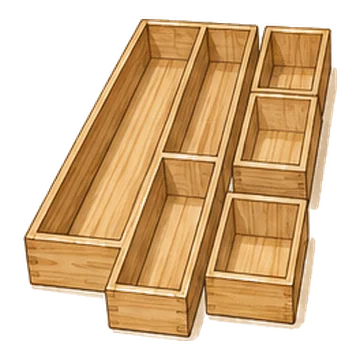
Spring-loaded bamboo dividers with inserts and labels for deep drawers.
Check price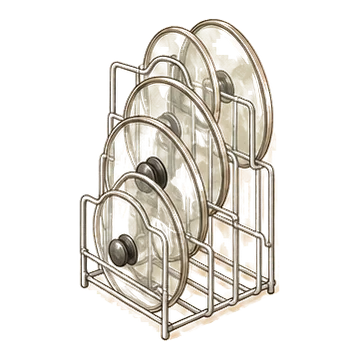
A rack that holds pot lids on the inside of a cabinet door or wall.
Check price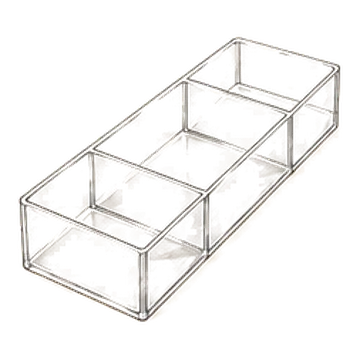
Twenty-five clear organizer trays in four sizes for vanity, bathroom and desk drawers.
Check price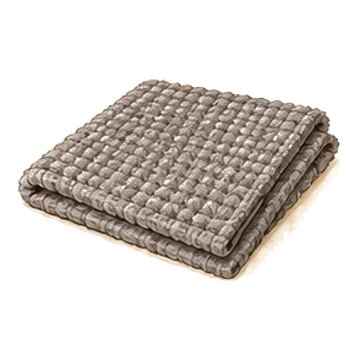
A thick non-adhesive liner that protects kitchen cabinets and drawers.
Check price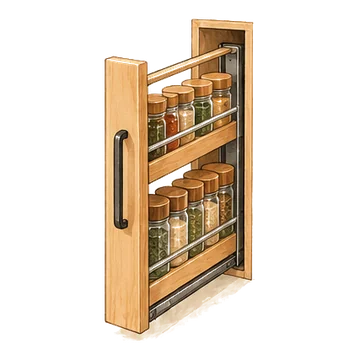
A slim slide-out spice rack for a narrow cabinet.
Check priceGive each drawer one job based on where it sits, edit duplicates, measure the inside and use trays that fit wall to wall. Keep shallow drawers to one layer and file bulky items upright in deep drawers.
Flat, everyday tools: silverware near the dishwasher, cooking utensils near the stove and measuring tools near the prep counter, all in a single layer.
Store things upright between dividers, like files. Cutting boards, baking sheets and container lids stand on edge, container bases nest beside them and pot lids can move to a rack on a cabinet door.
Measure the inside width at the front and back, the inside depth from front panel to back panel and the height to the frame above. Choose an organizer about a quarter inch smaller, or an expandable one.
Fill it with small trays so each type of item has a spot, keep it to one layer and empty it every season. Limit the kitchen to one junk drawer.
A non-adhesive liner is worth it in most drawers. It stops trays and tools from sliding, protects the drawer bottom and lifts out for cleaning.


