
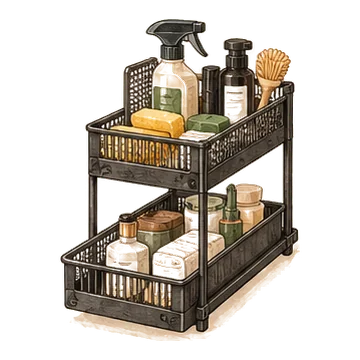
L-shaped 2-tier pull-out under-sink organizer
An L-shaped two-tier organizer with pull-out baskets that works around sink pipes.
Check priceThe cabinet under the kitchen sink is awkward storage: pipes in the middle, a door opening smaller than the space behind it and the constant chance of a slow drip. Plan around those three things and it holds far more than you would expect. Here is how to measure it, zone it and keep it dry, with a printable checklist at the end.
As an Amazon Associate I earn from qualifying purchases. Links on this page are affiliate links: if you buy through them, I may earn a small commission at no extra cost to you.

Part of our guide: Small Kitchen Organization Ideas: A Zone-by-Zone Plan →
The plan that works in most kitchens is simple. Empty the cabinet, keep only what you use at the sink, put sliding baskets on either side of the drain, use the doors for light items and line the floor so a leak shows up before it ruins the cabinet.
Expect one to two hours for the whole job, plus time to shop. Most of that is emptying, sorting and wiping the cabinet, not installing anything.
In a small kitchen this cabinet often has to hold more than spray bottles, so every inch counts. The sections below go through measuring, layout, products that work around plumbing, leak protection and safety.
The space works best when it holds things you use at the sink or within a step of it. That keeps the cabinet from becoming overflow for the whole kitchen.
Good candidates are dish soap refills, dishwasher detergent, sponges and scrub brushes, the all-purpose spray you use daily, trash bags, rubber gloves, a small bucket and a few rags. If there is room after that, a backup roll of paper towels can live here in a closed bin.
Keep food, pet food and anything you eat from out of this cabinet. Cleaners and food should not share a shelf, and a leak or a tipped bottle ruins open packages fast. Also skip things that do not like damp air, such as cardboard boxes of spares and anything with batteries.
Move rarely used products, like oven cleaner or silver polish you reach for twice a year, to a higher shelf in a utility closet. In a small kitchen, the sink cabinet is prime space for daily items only.
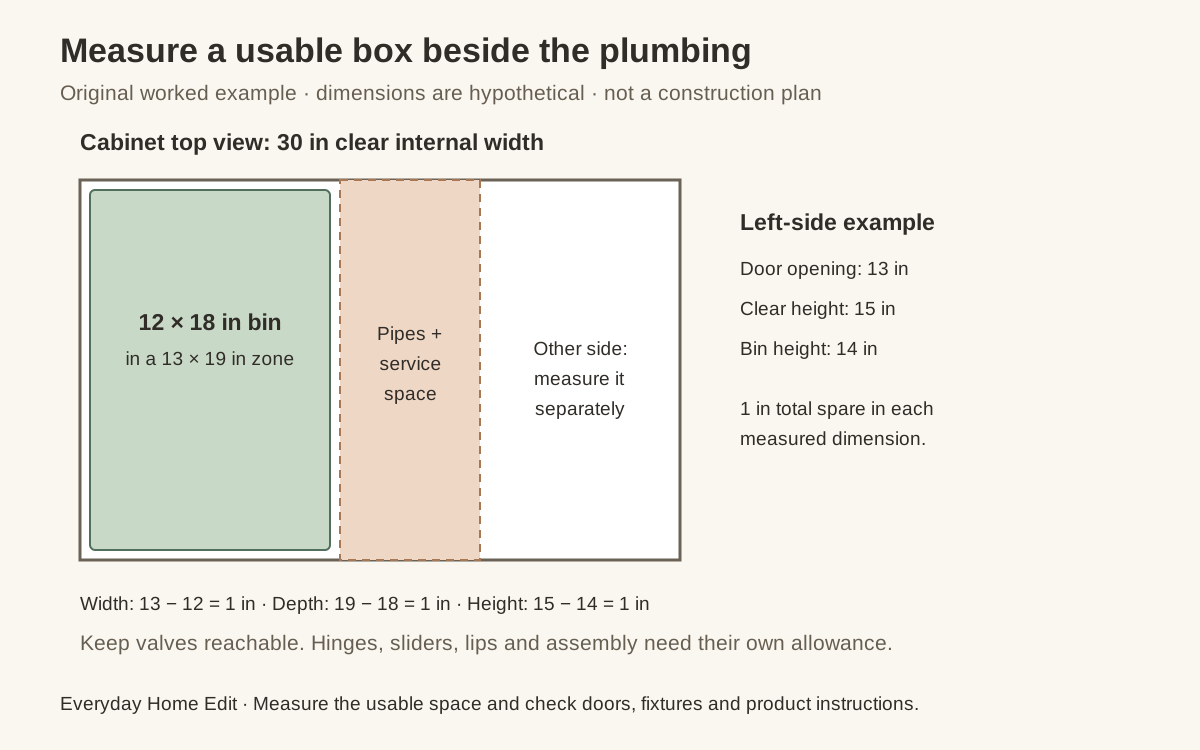
Treat each side of the plumbing as a separate usable box. The outside cabinet width does not tell you whether a basket will pass the door frame, clear a hinge or sit beneath the lowest pipe. In this hypothetical example, the left door opens 13 in wide and the left usable box is 13 in wide, 19 in deep and 15 in high.
Candidate A measures 12 × 18 × 14 in on the outside. It leaves 1 in total in each measured direction: 13 − 12, 19 − 18 and 15 − 14. If centered side to side, that is 0.5 in on each side. This establishes only that its rectangular envelope fits the stated clear box; mounting feet, sliders, a raised lip and handles must be included in those outside measurements.
Candidate B is 14 in wide. It does not pass upright through the 13 in door opening, even if the space farther inside the cabinet is wider. Do not buy a rigid assembled basket on the assumption that it can be tilted through; check the actual assembly and installation route.
Candidate C is 20 in deep. Its back would extend 1 in beyond the 19 in clear depth. Removing a shelf or pushing a hose aside is not part of this calculation. Choose a shallower organizer or use a different clear zone.
Finally, check the movement rather than just the parked basket. Pull it out all the way, keep valves accessible and leave the manufacturer-required installation space. A side that fits one bin does not prove the other side fits an identical one; a disposal, filter or off-center drain often changes the second box.
| Hypothetical organizer | Outside W × D × H | Measured result |
|---|---|---|
| A: compact basket | 12 × 18 × 14 in | 1 in total spare in each dimension |
| B: wider basket | 14 × 18 × 14 in | 1 in wider than the upright door opening |
| C: deeper basket | 12 × 20 × 14 in | 1 in deeper than the clear box |
Most organizers that fail under a sink fail because of one measurement nobody took. Sink base cabinets are usually 30 to 36 inches wide and about 24 inches deep on the outside, but the usable space inside is smaller and split by plumbing. Take five minutes with a tape measure and write the numbers down.
Once you have the numbers, stop thinking of the cabinet as one dark box. It is really three separate areas, and each one has a job.
The two sides of the drain are your main storage. They are usually the only spots with enough height for tiered baskets, so they hold the heavier bottles and refills.
The front strip, the first few inches inside the doors, is for what you grab every day: dish soap refill, sponges and gloves. If you have to move something to reach these, the setup is too deep.
The back of the cabinet, behind the pipes, is the hardest to reach. Use it for backstock you touch once a month, like spare trash bags or a second box of dishwasher detergent, and keep a clear path to the shutoff valves.
If you have a garbage disposal, the side under it usually has less height. Plan that side for short items or a single low bin.
Sliding baskets are the most useful upgrade for this cabinet because they bring the back of the space to you. Instead of kneeling and reaching past the drain, you pull a basket forward, take what you need and slide it back.
When the drain sits off to one side, an L-shaped organizer is worth a look. The L-shaped 2-tier pull-out under-sink organizer is designed to work around sink pipes, with pull-out baskets on two levels, so it uses the corner a rectangular unit would leave empty.
With the drain in the middle, two narrow units, one on each side, usually fit better than one wide unit. The DEKAVA 2-tier sliding under-sink organizer comes as a 2 pack of sliding two-tier baskets, which suits that left-and-right setup.
Check the height of any two-tier unit against your measurement under the sink bowl on that side. If the top tier would touch the bowl or the drain, use a single bin on that side instead.
Load the lower tier with heavier refills and the upper tier with lighter daily items. Keep bottles upright with caps tightened, so a drip stays in the basket.

Back corners are where bottles go to be forgotten. A turntable fixes that, because one spin brings the back row to the front. The OXO Good Grips 16 inch lazy Susan turntable is a rotating, non-slip 16 inch turntable, so it needs a clear square at least 16 inches wide and deep, plus room for bottles to clear the walls as it turns.
On many 30-inch sink cabinets, a 16-inch turntable fits on one side of the drain only, and only if the pipe is not far off center. Put the tallest bottles in the middle so they do not catch on the frame.
There is often wasted height between the tops of the bottles and the bottom of the sink. A spring tension rod set across one side, a few inches below the sink, can hold spray bottles by their triggers and free the floor for a bin or bucket. Test it with one full bottle before adding the rest.
Lidless bins with handles work well for loose small things like scrub brushes, sponges and dishwasher pods. Pull the whole bin to the counter, use what you need and put it back.
The inside of the cabinet doors is usable storage, as long as what you hang there is light and flat enough for the door to close. Measure the gap between the closed door and the front of the sink or the nearest basket first. On many cabinets it is only an inch or two.
Adhesive hooks are the simplest option and need no drilling, which matters if you rent. The Command large utility hooks, 7 pack, are damage-free hooks made for towels and similar items, so a cleaning rag can dry on the door instead of sitting balled up in a corner. The Clear adhesive wall hooks, heavy duty, 12 pack, are smaller clear no-drill hooks for towels, mitts and utensils, handy for a dish brush with a hanging loop.
Wipe the door with rubbing alcohol and let it dry before you stick anything on, and follow the package's wait time before loading a hook. Adhesive struggles on damp or textured surfaces.
The side walls count too. A hook on the inside wall near the front holds rubber gloves, and a slim box of trash bags can stand on its edge against a wall.

The floor of a sink cabinet is often particleboard or a similar engineered wood, which swells and crumbles when it stays wet. A slow leak can go unnoticed for weeks when the cabinet is packed full.
A raised-edge mat is the easiest protection. The Waterproof under-sink silicone mat is a 34 by 22 inch silicone tray with raised edges that catches drips and leaks before they reach the cabinet floor. Check that size against your cabinet floor before you buy, since it suits a wider sink base.
A light-colored mat also makes drips easy to see. Once a month, glance at the mat, run a dry paper towel around the supply lines and drain joints, and check the floor under the disposal. A water spot caught early is a quick fix; a soaked cabinet floor is not.
Keep at least a hand-width path to the shutoff valves. If a supply line ever fails, you want to reach them in seconds without pulling out three bins first.
The sink cabinet sits at toddler height and often holds the strongest cleaners in the house. If young children live with you or visit, add child-safety latches to the doors, or move the harshest products up high and keep only dish soap and sponges down low.
Keep every cleaner in its original, labeled container with the cap on tight. Never pour a cleaner into a food or drink container, even for a moment.
Store bleach and ammonia-based products in separate bins, and never mix cleaners. Some combinations, such as bleach with ammonia or bleach with acidic cleaners, release dangerous gases.
Pets explore low cabinets too. A latch protects them as well, and a lidded trash bin keeps curious noses out of the garbage.
You do not need a full system on day one. Pick the tier that fits your budget now and add pieces later.
Low: declutter, group supplies in bins or shoeboxes you already own, add a tension rod for spray bottles and a few adhesive hooks on the door, and line the floor with a piece of shelf liner.
Medium: add sliding two-tier baskets on each side of the drain, a waterproof mat with raised edges and a turntable for one back corner.
Splurge: a custom pull-out drawer built around your plumbing by a cabinet maker. If you own your home and use this cabinet heavily, this is the version that feels built in.
Renters can do almost all of this without tools. Freestanding baskets, turntables, tension rods, a mat and adhesive hooks come out cleanly when you move. Skip anything that screws into the cabinet floor or doors unless your landlord agrees.

Most under-sink setups fall apart within a month for the same few reasons.
To keep it working, do a two-minute reset whenever you open a new refill: toss the empty, move the new one to the front and glance at the mat. Once a season, pull everything out, wipe the cabinet and let go of anything you have not used.
An L-shaped two-tier organizer with pull-out baskets that works around sink pipes.
Check priceTwo sliding two-tier baskets for under the kitchen or bathroom sink.
Check price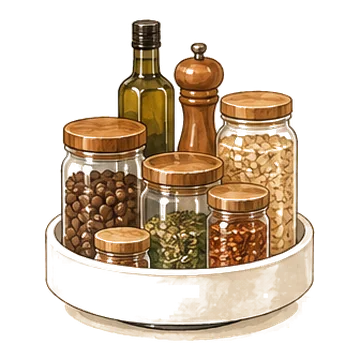
A 16 inch turntable for oils, spices or fridge jars.
Check price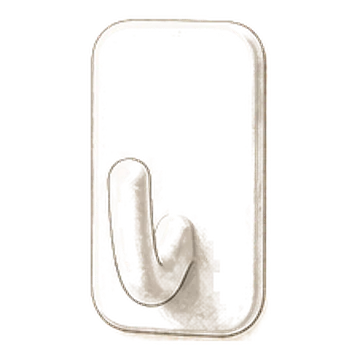
Damage-free adhesive wall hooks for coats, bags and towels.
Check priceClear no-drill hooks for towels, mitts and utensils.
Check price
A silicone tray with raised edges that protects the cabinet under the sink from drips and leaks.
Check priceEmpty it, keep only sink-related supplies, put sliding baskets on each side of the drain, use the doors for light items and line the floor with a waterproof mat. Measure the door opening and the space under the pipes before buying anything.
Treat the side under the disposal as low storage for short items or a single bin, and put taller tiered baskets on the other side. Keep the disposal's cord, switch and the area around it clear.
Food, pet food, anything with batteries, rarely used products and things that moisture damages, such as cardboard boxes. If young children are around, move the harshest cleaners up high or add latches.
Use a waterproof mat or liner with raised edges, keep the cabinet loose enough that you can see the floor, and check the supply lines and drain joints for drips about once a month.
Yes. Freestanding sliding baskets, turntables, tension rods, a silicone mat and adhesive hooks all go in without tools, which makes them a good fit for renters.
Check three numbers: the width of the door opening, the depth from the frame to the back wall and the height from the cabinet floor to the bottom of the pipes or sink bowl. Leave about half an inch of clearance on each.


